South Florida Drug Offenses: Types, Consequences & Legal Defense
In South Florida, the typical drug case can range from simple possession of a small amount of weed to the importing of thousands of kilos of cocaine. Whether this is your first or fifth arrest, you probably have many questions.
What Drugs are Illegal?
The following are some of the drugs that are considered illegal in the state of Florida (click for more information):
Marijuana
Although recreational use of Marijuana is permitted in the state of Florida with a medical Marijuana card, Marijuana is still illegal in the state of Florida regardless of the amount. Visit our Marijuana page for more information on the legality of Marijuana in Florida and penalties regarding the drug.
Heroin
Heroin
Possession
In Florida, possessing even trace amounts of heroin is illegal. In Florida Statutes Section you can be considered in actual or constructive possession of heroin. Actual possession is when the drug is on your person or very close to you. For example, if you were caught with heroin in your purse.
Constructive possession is a little more complex. Prosecutors must prove multiple elements to charge you with constructive possession including:
- You knew of the controlled substance presence
- You had control or ownership over the drug
- The substance was heroin or a mixture of heroin
An example is if law enforcement found drugs in a rented storage room under your name.
Trafficking
The charges for heroin trafficking in Florida are typically as follows:
- 4 grams to 14 grams: 3 years in prison & $50,000 fine
- 14 grams to 28 grams: 15 years in prison & $100,000 fine
- 28 grams to 30 kilograms: 25 years in prison & $500,000 fine
- 30 kilograms or more: life in prison & $500,000 fine
Visit Online Sunshine to read up on their laws for heroin possession, sale, manufacture, or delivery in Florida.
Cocaine
Cocaine
Cocaine is the third most widely-used recreational drug nationwide. In the State of Florida, cocaine is categorized as a Schedule II controlled substance and is illegal to possess.
Possession
Possession of cocaine is considered a third-degree felony in Florida. It is punishable by a maximum of five years in prison, five years probation, and/or a $5,000 fine. It is also unlawful for any person to possess cocaine with the intent to sell, manufacture, or deliver it to someone. Possession of cocaine with intent to sell or deliver is a second-degree felony punishable by 15 years in prison, 15 years probation, and/or a $10,000 fine.
Trafficking
The charges for cocaine trafficking in Florida are typically as follows:
- 28 grams to 200 grams: 3 years in prison & $50,000 fine
- 200 grams to 400 grams: 7 years in prison & $100,000 fine
- 400 grams to 150 kilograms: 15 years in prison & $250,000 fine
LSD
LSD
Possession
LSD is federally classified as a Schedule I controlled substance, which means that there are no recognized medical uses for this drug and the potential for abuse is considered high. Therefore, penalties can be steep for something as simple as possession. In florida consequences for LSD possession are as follows:
- Less than one gram: punishable by up to five years in prison and a two year driver’s license suspension.
- More than one gram (but less than 4.99 grams): punishable by a a sentence of between three and 30 years in prison.
- 5 to 6.99 grams: punishable by a minimum prison sentence of seven years and a fine of $100,000.
- More than seven grams: punishable by prison for a minimum of 15 years and a fine of $500,000.
Trafficking
In order to secure a conviction for LSD trafficking, a prosecutor needs to prove beyond a reasonable doubt that you knowingly possessed, sold, purchased, made, delivered, or carried into the state one gram or more of either acid or a mixture that contained LSD and another drug. In Florida, the potential penalties for LSD trafficking are as follows:
- 1 gram to 5 grams: 3 years in prison & $50,000 fine
- 5 grams to 7 grams: 7 years in prison & $100,000 fine
- 7 grams or more: 15 years in prison & $500,000 fine
Xanax
Xanax
In the state of Florida, Xanax is a Schedule IV controlled substance, meaning it is legally considered to have a low abuse potential, and is accepted currently for medical use both nationally and in Florida. However, the crime of possession of Xanax is a Third Degree Felony and punishments include up to five years in prison, five years of probation, a $5,000 fine and a six month driver’s lisence suspension. In the State of Florida, if you were caught with over four grams of Xanax pills, you may face a mandatory minimum sentence of three years. For higher amounts, it is possible to face a mandatory life sentence. With a good Attorney, however, you could avoid jail time all together in some cases. This is why hiring an experienced defense lawyer like Michael Jones is at the utmost importance.
Oxycodone
Oxycodone
Possession
Unlawful possession of Oxycodone is a third degree felony in Florida punishable by up to five years in prison, unless the accused has a valid prescription for the controlled substance. Oxycodone is a Schedule 2 controlled substance. A charge of possession will also cause a driver’s license suspension.
The minimum mandatory penalties for Trafficking in Oxycodone (Oxycontin) are as follows:
- Possession of 7 and 14 grams: between three and 30 years of jail time, a fine of up to $50,000, and a minimum prison sentence of three years.
- Possession of 14 to 25 grams: jail term of seven to 30 years in prison with a potential fine of up to $100,000.
- Possession of 25 to 100 grams: jail term of 15 to 30 years in prison with a potential fine of up to $500,000.
- Possession of 100 grams to 30 Kilos: jail term 25 to 30 years in prison with a fine of up to $750,000.
Trafficking
The penalties for trafficking Oxycodone in Florida are as follows:
- 7 grams to 14 grams: 3 years in prison & $50,000 fine
- 14 grams to 25 grams: 7 years in prison & $100,000 fine
- 25 grams to 100 grams: 15 years in prison & $500,000 fine
- 100 grams to 30 kilograms: 25 years in prison & $750,000 fine
Methamphetamines
Methamphetamine
Possession
Possession of methamphetamine is a third-degree felony that carries up to five years in prison and/or a $5,000 fine.
Trafficking
The charges for Meth trafficking in Florida are typically as follows:
- 14 grams to 28 grams: 3 years in prison & $50,000 fine
- 28 grams to 200 grams: 7 years in prison & $100,000 fine
- 200 grams or more: 15 years in prison & $250,000 fine
Ecstasy
Ecstasy
Possession
Possession of ecstasy, or Molly, in any capacity is illegal according to Florida law. The drug has no place in medicine, so the penalties for possessing it can be exceedingly harsh. MDMA or ecstasy is often associated with concerts, raves, and other events. Most people charged with ecstasy possession are not drug offenders, but simply used the drug to have a good time. Unfortunately, the state of Florida isn’t very forgiving when it comes to possession of illegal substances. Possession of MDMA, Ecstasy, or Molly is a third-degree felony. The maximum punishment for a third-degree felony includes:
- 5 years in prison
- Fines of up to $5,000
- 5-year probation
- License suspension for up to 6 months
Trafficking
The charges for Meth trafficking in Florida are typically as follows:
- 10 grams to 200 grams: 3 years in prison & $50,000 fine
- 200 grams to 400 grams: 7 years in prison & $100,000 fine
- 400 grams or more: 15 years in prison & $250,000 fine
Unauthorized Prescription Medications
Prescription drugs are regulated substances that can be legally prescribed but are subject to the same classification system, charges, and penalties as illegal narcotics. A defendant may face charges for the unlawful possession, possession with intent, sale, distribution, manufacturing, or trafficking of prescription drugs.
Prescription Medications include:
- Codeine
- OxyContin
- Hydrocodone
- Vicodin
- Oxycodone
- Xanax
Drug cases, especially those dealing with unauthorized prescription medications, have individual flaws and penalties that can vary widely. We recommend contacting a criminal defense attorney like Michael Jones to handle your case and walk you through your charges during a free consultation.
To learn more about Florida’s laws involving prescription drugs, visit Online Sunshine.
What is a Drug Offense?
A drug offense is a criminal act that involves the use, possession, sale, or distribution of an illegal drug. Any person who sells, possesses, or distributes an unlawful substance can be charged with a drug offense by all South Florida law enforcement including Boca Raton or Ft. Lauderdale police. The extent and severity of criminal charges vary case per case, but will normally depend upon the type of drug, amount of the drug, and the defendant’s prior criminal record.
What are the Potential Consequences of a Drug Offense?
Drug crimes carry harsh penalties. Even the most mild of drug crimes, simple possession, is generally considered a felony punishable by up to 30 years in prison and $10,000 fine. The severity of the alleged crime can lead to up to a lifetime prison sentence. However, if you are facing a first-time possession charge, you may or may not go to jail. This is why it is extremely important to have a well-experienced defense attorney like Attorney Michale Jones, to fight for you, leading to reduced penalties or even the complete dismissal of your case.
Once a person is convicted of a drug offense in South Florida, he/she can be punished with:
» Imprisonment
» Fines
» Community service
» Probation
» Mandatory Counseling
» House Arrest
What are the Types of Drug Crimes?
Due to the severity of the legal consequences involved, it is always to your benefit to speak with a qualified criminal defense attorney after you have been charged with a drug crime. Common drug crimes in Florida include:
» Drug Possession
» Drug Possession w/ Intent to Sell
» Drug Trafficking
» Drug Manufacturing
» Possession of Paraphernalia
» Drug Cultivation
» Unauthorized Prescription
What is Drug Scheduling? (Drug Classification Chart)
Drugs are classified into five distinct categories, or “schedules,” depending on the drug’s acceptable medical use and dependency potential.
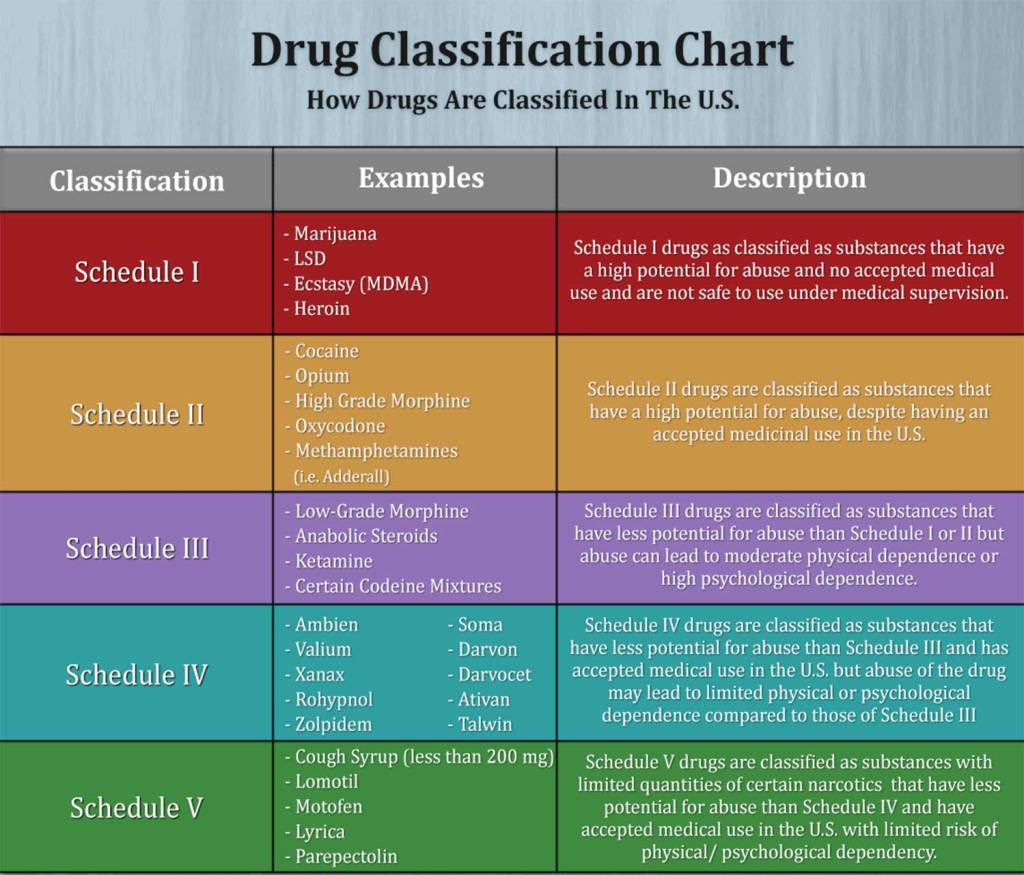
The above chart is from Pines Recovery Life .
For more Information Visit the DEA.gov.
What is Actual Possession versus Constructive Possession?
“Actual possession” is having a type of illegal drug found on your person such as in a pocket, wallet or handbag as well as in a person’s hands or hidden within other parts of the body when an arrest takes place.
“Constructive possession” is when a person does not have physical custody of the drug, but has the ability to control it or have access to it. An example would be if drugs were found in a storage locker you own. Another example would be if multiple persons were in a public area such as a park when law enforcement observed what they believed to be cocaine on a picnic table, or other area adjacent and easily obtainable by the people nearby. In cases like this there may be multiple arrests depending on numerous factors.
What Amount of Drugs can Lead to a Drug Offense?
Unfortunately, even what most would consider a “small” amount of drugs can lead to devastating criminal consequences. The important number to know in Florida is 28. If you are found with 28 grams of a drug under your possession, it becomes a drug trafficking offense, even if you never intended to sell the drug.
The trained eye of an experienced criminal defense attorney must examine each case for potential “flaws” that will work in your favor. It is up to you, however, to contact the right Attorney to investigate your case!
How Can I Fight a Drug Charge?
The most important step in fighting a drug charge is choosing the right attorney. Attorney Michael Jones has successfully handled over 1,000 drug cases in his over 30 years of practice. These clients almost always leave with severely reduced charges or a complete dismissal of their case.
If the state of Florida wants to prove you committed a drug crime, they need evidence. Michael Jones will ensure your rights aren’t being violated for a bogus conviction. An unlawful stop and/or seizure or self-incrimination (which the law guarantees people be free from) can cause the proof in your case to be inadmissible. Answering these questions can help you determine if your constitutional rights have been violated:
- Were you stopped for a lawful reason?
- Did the police officer have the right to search your person, property, or vehicle?
- Did you consent to a search of your person, property, or vehicle?
- Did law enforcement read your Miranda rights?
Other potential defenses Michael Jones will argue for you include:
- Mere proximity to the drug does not establish possession
- Temporary possession
- Entrapment
- Having a legal Prescription for the drug
The Law Office of Michael E. Jones is a South Florida criminal defense firm servicing clients throughout Broward, Miami-Dade and Palm Beach counties. Criminal defense attorney, Michael E. Jones, is devoted to helping his clients contest their drug crime charges. As a committed solo practitioner, Mr. Jones strives to give each of his clients the attention and counsel they need to be successful with their drug offense matters. He will always go the extra mile for his clients’ and their criminal cases.
If you have been charged with a drug offense in South Florida, call or contact the Law Office of Michael E. Jones today for your free initial consultation at (954) 764-2060.
With over 30 years of experience and thousands of successful cases under his belt, Michael Jones will be there for you throughout the entire process, fighting for you until the very end. At the Law Office of Michael E. Jones, we can answer your questions and address your individual concerns. You do not have to go through the criminal process alone.
I can order a copy of your police report and offer you a consultation at no charge.
Available 24/7
 Michael Jones Law